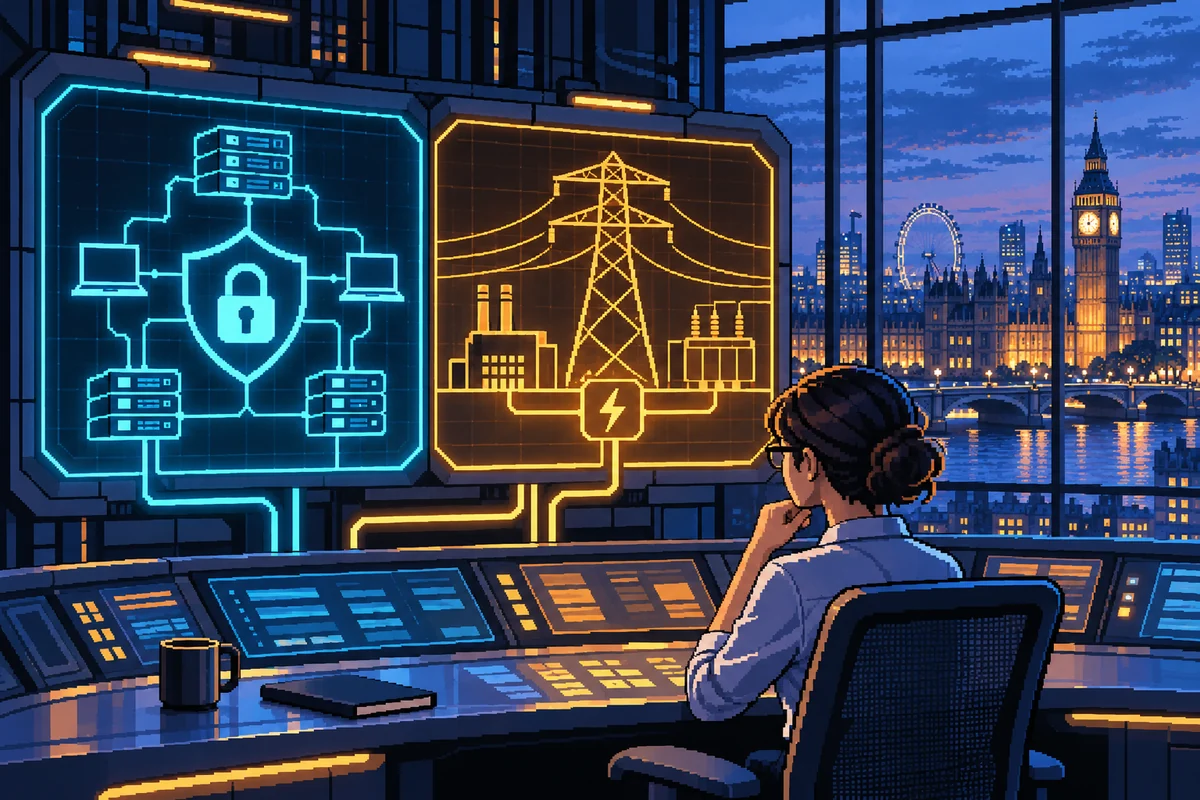
Geoffrey Hinton warned about possible AI-enabled disruption; he did not report a blackout. The useful question is which risk is being discussed. A malicious intrusion, a constrained electricity grid and an unavailable AI API can all interrupt services, but they have different causes and responses. This article uses current NCSC and IEA material to separate those paths, then applies the distinction to a small app’s fallback design. Checked on 8 November 2026; no outage prediction or firsthand incident is claimed.
What does “AI blackout” mean in the claim you are reading?
Start by naming the affected system. An electricity interruption concerns generation, networks, protection systems and local operating conditions. A cyber incident concerns access, integrity, availability and the systems an attacker can reach. An API outage concerns the service an application depends on. These can interact, but one is not evidence for another. A chatbot timing out on your phone cannot tell you whether a region’s grid is under attack.
That distinction changes the question you ask next. For a power interruption, look for the relevant utility or grid operator’s status. For an AI service error, check the provider’s status and your own request traces. For a suspected security incident, preserve evidence and follow an incident process. A viral warning is not a status page, and an alarming screenshot is not a root-cause analysis. Establishing what actually failed comes before explaining why.
What the new NCSC assessment actually establishes
The NCSC’s Artificial intelligence and cyber intrusion assessment was published on 3 November 2026 and examines the threat landscape through 2028. It describes three plausible scenarios and explicitly distinguishes those scenarios from predictions. Its judgments include concern about AI-assisted exploitation and exposure in critical infrastructure. It is a risk assessment to inform preparation, not a calendar showing when a particular country will lose power.
When reading an assessment, preserve its scope and uncertainty language. A statement about possible future misuse is not evidence that a named service was attacked today. Equally, uncertainty is not a reason to ignore ordinary defensive work. The practical use of this document is to ask whether known weaknesses are patched, access is constrained and recovery can be exercised. Those questions are useful even if the precise scenario that eventually occurs differs from the one in a headline.
Two infrastructure risks need different evidence
These conceptual paths describe questions to investigate, not a prediction that either chain will occur.
Cyber exposure
- Reachable weakness
Identify the exposed system and authorized access paths.
- Service impact
Determine whether an intrusion actually affected operations.
Capacity pressure
- Local demand and supply
Identify the location, time and network constraints.
- Operating outcome
Use operator evidence to establish interruption or mitigation.
Do not infer an actual blackout from a threat scenario or a global demand projection.
Power demand is a different evidence trail
The IEA’s 2026 Key Questions on Energy and AI report discusses growing data-centre electricity demand, grid connections and supply-chain constraints. It also describes uncertainty around usage patterns and efficiency. Those are relevant to planning. They do not establish the cause of an individual local interruption. The location of a facility, the timing of its load and the capacity of its network matter more to that diagnosis than a worldwide headline number.
A useful article should therefore resist the shortcut from “AI uses electricity” to “this outage was caused by AI.” You would need local evidence about the event and the system’s response. The same discipline applies in reverse: a period with no interruption does not settle a long-term capacity question. Keep the timescale visible. An annual planning outlook, a cyber threat scenario and a live incident update answer different questions and should not be combined into one certainty.
A practical AI app fallback starts with a truthful interface
Consider a hypothetical coaching app whose AI explanation request times out while a user views an already saved workout. The interface can keep the saved plan available and mark the explanation unavailable. It should not generate a confident substitute, claim the plan was changed or erase the user’s entries. This is an invented teaching example, not an account of a production outage in UltraFit360. The important design decision is preserving what the app actually knows.
Design this state before an outage happens. Decide which data is authoritative, which actions require a successful server response and which content can be read from an allowed cache. A retry button should describe what it will retry. If an earlier write might have succeeded, the client needs a way to reconcile it rather than sending the same change repeatedly. A successful-looking animation cannot stand in for a confirmed save.
- Keep saved information visibly distinct from a fresh AI response.
- Show a bounded error state and a useful next action.
- Reconcile uncertain writes before presenting a final result.
- Avoid exposing private prompts or personal data in an error message.
- Keep support and essential navigation usable when the AI feature is unavailable.
Retry behavior can make a small outage larger
A dependency failure is not a reason for every client to request continuously. Repeated attempts without a limit can increase load at the moment the service is least able to handle it. For a proposed retry policy, define a total time budget, increasing delays and a terminal state. Separate the user’s deliberate retry from automatic retries so the combined number of attempts remains understandable. Respect provider instructions where they are supplied.
Different operations need different recovery rules. A read-only explanation request can often be retried without changing saved state. A payment, booking or plan update needs explicit duplicate handling and authoritative verification. This article is not changing TechNightCity’s payment integration; it is explaining why an application should not apply one retry policy to every endpoint. The safer interface admits uncertainty while checking the record, instead of converting a timeout into either “definitely failed” or “definitely completed.”
A request can fail without losing the saved record
An illustrative app flow separates reading saved information from requesting a new explanation.
Known state
- Read saved record
Display the last confirmed version and its status.
- Request explanation
Treat generated text as a separate dependency.
Recovery
- Bound the wait
Return control to the user with a clear unavailable state.
- Reconcile and retry
Confirm uncertain writes before repeating an action.
Preserve known data and admit uncertainty about unconfirmed operations.
Test a failure you can actually reproduce
For a small team, an actionable first exercise is a controlled dependency failure in a test environment. Arrange for the AI request to return a timeout or an explicit error. Then check whether the UI remains navigable, whether saved information stays intact and whether a retry can recover. Use synthetic records and a stubbed service. There is no need to disrupt a real provider, overload an endpoint or simulate a critical-infrastructure attack.
Record what you expected before running the exercise. “The page still renders” is too weak if its main button falsely reports success. Check keyboard focus, screen-reader status, cancellation and the path back to the last known record. Inspect the request count as well as the screen. The test is valuable because it produces evidence about your application, rather than borrowing certainty from a general warning about AI. Repeat it when the failure-handling code changes.
Scroll the table horizontally to see all columns.
| Controlled test | Expected user-visible behavior | Evidence to record |
|---|---|---|
| Read request timeout | Saved content stays readable; fresh answer marked unavailable | Rendered status and request duration |
| Write acknowledgement lost | No confident success until state is reconciled | Authoritative record and retry count |
| Dependency returns errors | Bounded attempts and a stable error state | Attempt count and final screen |
| Recovery after interruption | One clear transition back to current data | Record version and visible status |
What a useful response to the warning looks like
You do not need a confident blackout forecast to improve a product’s resilience. You need a clear inventory of dependencies, sensible access boundaries, recoverable records and an interface that does not lie when confirmation is missing. For infrastructure-level conclusions, defer to operator and specialist evidence. For your own application, build a small, repeatable exercise and document what it demonstrates. Keep those two kinds of authority separate.
Frequently asked questions
Did Hinton report that an AI blackout had happened? The statement discussed here is a warning about possible disruption, not a report establishing a particular blackout. Check the relevant operator’s incident information for a real event.
Does higher AI electricity demand prove an outage was caused by AI? No. Aggregate demand and local incident causation are different questions. A local explanation needs evidence about the affected network, timing, operating conditions and the event itself.
What can a small AI app team do now? Exercise a controlled dependency timeout, preserve saved records, bound retries and make uncertain operations visible. These practical checks do not depend on predicting an infrastructure incident.
Sources
- NCSC: Artificial intelligence and cyber intrusion, 3 November 2026
- IEA: Key Questions on Energy and AI, 2026
- Original Hinton interview: warning context
Technical references checked .

Eeshan Singh
I’m Eeshan Singh Pokharia, an AI Full Stack Developer and CoFounder of UltraFit360. I work across AI features, full-stack product development, and web and mobile experiences—from Figma and frontend interactions to the systems behind them.
Building an AI-facing interface makes me interested in what happens when the dependency stops responding. This is a defensive product-design exercise, not a claim that our app experienced the incidents discussed or that I operate electricity infrastructure.
Meet the author