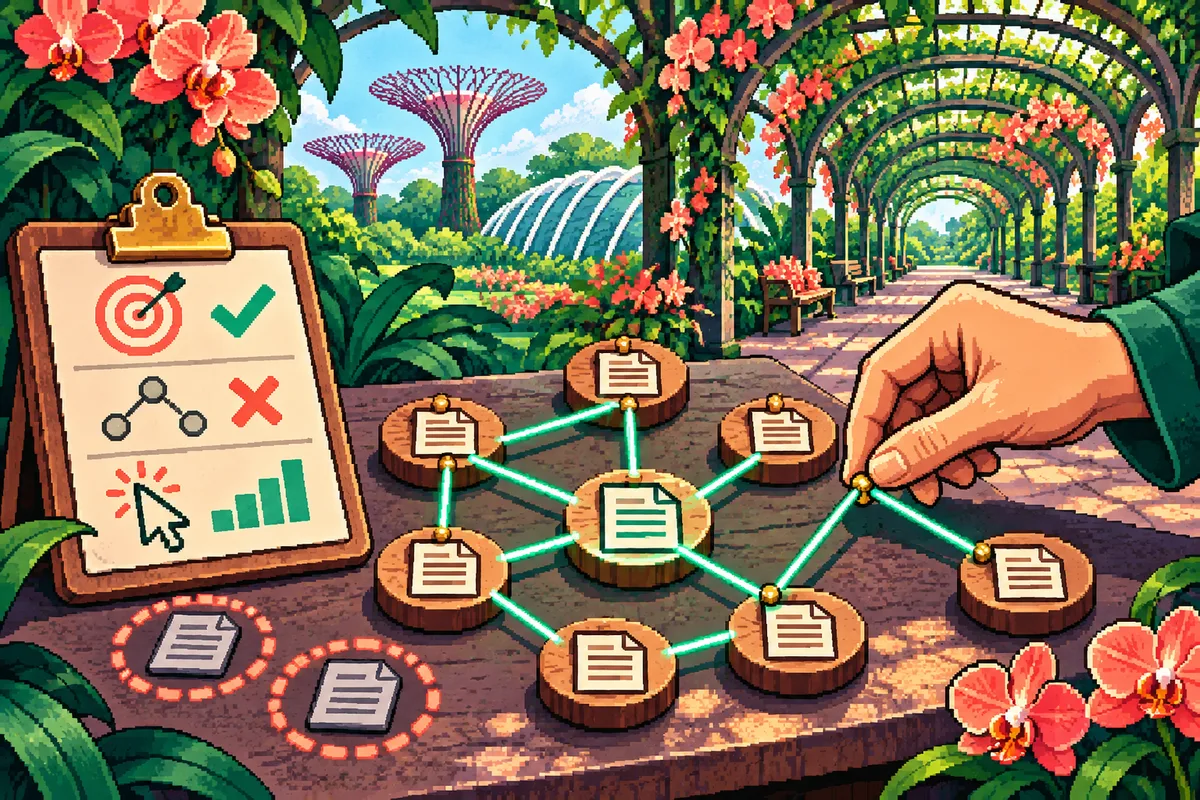
Build a related-article graph from reader journeys. Start with the action a reader can take after finishing the current article.
Build the example
Connect an Expo release overview to focused pages on environment variables and deep links, and connect each focused page back to the relevant overview. Keep each link labelled with the task it enables. Validate destinations against the published route registry and prevent self-links, duplicates and links into preview-only pages.
Put the proposed links in a small adjacency list and run a check for unknown paths before rendering. Try deleting one article and confirm the check identifies both its missing route and any incoming references. Prefer a named editorial replacement when a related post disappears, and revisit the link text when its target changes focus.
Watch the failure boundary
Make article titles readable outside their own pages so a contextual link gives visitors a clear next action. Test all links from the prerendered version as well as client navigation. Record when each editorial path was reviewed, especially if an older article changes its scope or an existing article absorbs a newer one.
Verify the behavior
Run a graph check that finds eligible pages with no incoming contextual links. Fix those through relevant editorial placement instead of random links from the archive. Measure follow-through with consented analytics. Clicks can suggest a path is useful and are one signal alongside relevance and discoverability.
Sources
Technical references checked .

Eeshan Singh
I’m Eeshan Singh Pokharia, an AI Full Stack Developer and CoFounder of UltraFit360. I work across AI features, full-stack product development, and web and mobile experiences—from Figma and frontend interactions to the systems behind them.
Make article titles readable outside their own pages so a contextual link gives visitors a clear next action. Test all links from the prerendered version as well as client navigation. Record when each editorial path was reviewed, especially if an older article changes its scope or an existing article absorbs a newer one.
Meet the author