A strong developer portfolio explains a problem you can reason about, a decision you made and evidence that the result works. In an AI-assisted workflow, that is more informative than a long technology list or an unsupported claim that everything was built from scratch. Show the bug, the fix, the trade-off and the verification.
Start with a concrete user failure
Instead of saying the application had performance issues, describe the trigger and observed behaviour. For example, an invented archive might render every card at once and become difficult to scroll on a narrow device. The reader can now understand what changed and why it mattered.
Separate observation from measurement. If you have a trace, report its method and conditions. If you only observed a visible delay, say that. Do not turn a subjective improvement into a precise percentage or invent a device test because a number looks more professional.
Explain the decision before listing libraries
What options did you consider, and which constraint mattered? In the archive example, pagination, incremental reveal and virtualisation have different implications for navigation, accessibility and discovery. A thoughtful explanation of the chosen trade-off demonstrates more judgement than naming a popular library.
Keep the alternatives relevant. You do not need a history of every framework to explain a small fix. Show the decision that changed behaviour, the limitation it accepts and why it fits the product at that stage.
A case study is an evidence chain
A practical narrative structure, not a promise of interviews or a recruitment ranking.
Problem and choice
- Concrete trigger
Describe what a user did and what went wrong.
- Decision
Explain the alternatives and the constraint that shaped the fix.
Implementation and proof
- Focused artefact
Show a permitted diff, diagram or independent toy example.
- Verification
State what was tested and what remains uncertain.
Make a reader able to assess your judgement rather than asking them to trust a technology badge.
Make your contribution explicit
Distinguish work you designed, implemented, reviewed or integrated from work owned by teammates and third-party tools. If a design began in Figma and an agent helped translate context, explain which decisions remained yours and how you verified the implementation.
Avoid both extremes: claiming sole authorship of a team's product and describing yourself as merely pressing a button. Concrete responsibilities are more credible. A public README can introduce the project, while the case study supplies the reasoning and evidence behind a particular change.
Scroll the table horizontally to see all columns.
| Portfolio claim | Better evidence | Weak substitute |
|---|---|---|
| Improved a slow page | Trace or documented before-and-after conditions | Unsupported percentage |
| Fixed a permissions bug | Disposable cross-user test | A screenshot of a success message |
| Built an interface | Design decisions, states and working interaction | Only a polished static image |
| Used AI responsibly | Reviewed diff and meaningful checks | A claim that the tool made no mistakes |
| Worked on a private product | Approved description or independent example | Private repository link or copied source |
Show failure states and constraints
A product is more than its happy screen. Include loading, empty, error and permission-denied states where they matter to the case. Explain how a keyboard user reaches the action or how a mobile layout handles long text. These details reveal implementation understanding.
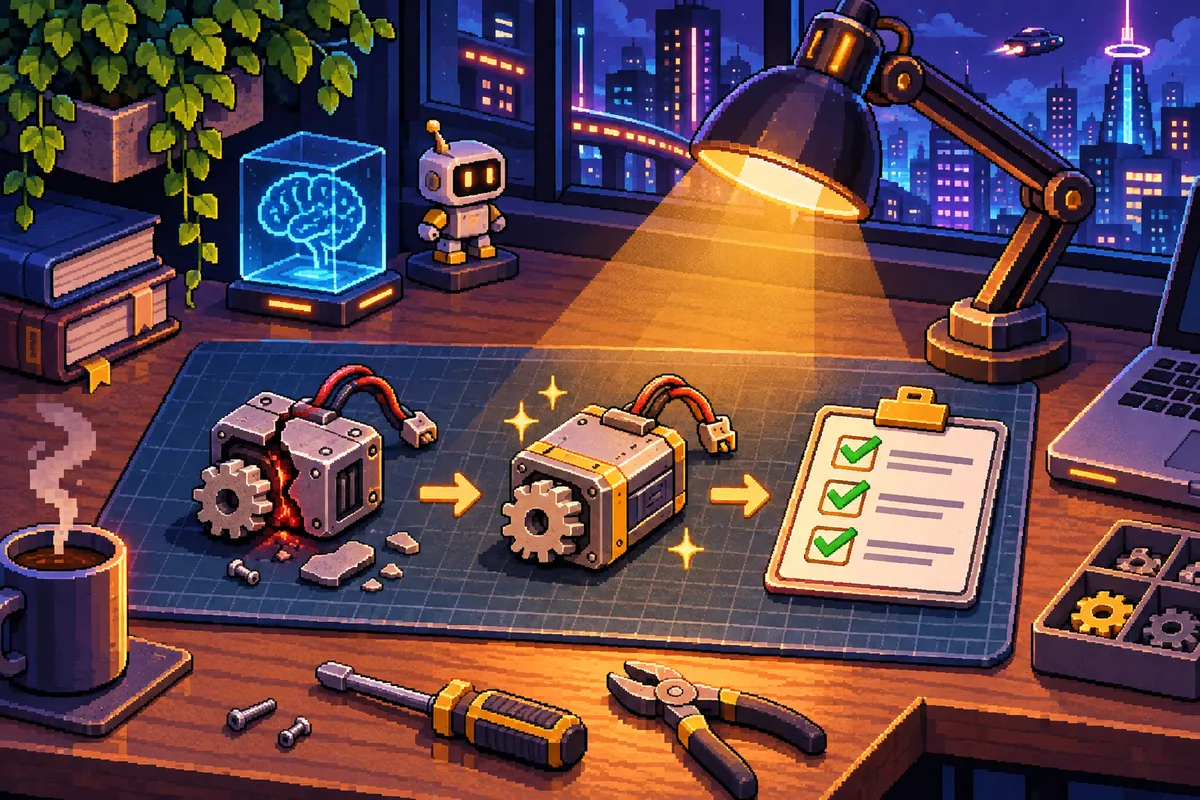
Do not crowd the case study with screenshots that do not explain anything. Use a diagram when the lesson is a state machine or data flow. Use an actual permitted screen when visual behaviour is the evidence. Label generated conceptual art so it is not mistaken for a device capture.
Verify at the right boundary
A build proves compilation and packaging, not every deployed integration. A unit test can verify a helper while missing a broken route. State which checks you ran and what they establish. If a provider or hardware test remains unavailable, name that limitation.
Keep tests meaningful. A test that repeats the implementation's assumptions without checking user behaviour adds little evidence. Prefer a regression fixture that fails for the original bug and passes for the intended result.
Publish safely and maintain the story
Review links, images, code and captions for private information. Remove credentials, customer data, internal hostnames and unapproved repository references. Keep public source attribution where it belongs and do not present another project's implementation as your own.
Update a case study when a material change alters its lesson, not daily to create artificial freshness. A short, accurate explanation with inspectable evidence can remain valuable long after a tool trend changes. The aim is to make your judgement visible and your claims easy to assess.
Frequently asked questions
Should I hide that I used AI coding tools? Describe your contribution accurately, including design, implementation, review and verification. Tool use does not remove your responsibility for understanding and maintaining the result.
Can I show private product code in a portfolio? Only with appropriate permission. Otherwise use a general explanation, approved public artefacts or an independently written toy example that excludes private identifiers and logic.
Does this case-study format guarantee a job? No. It improves the clarity and assessability of your work, but hiring depends on many factors and no outcome guarantee is supported here.
Sources
- GitHub: profile README; supports portfolio presentation, not hiring outcome claims
- Google: people-first content
- Related practical guide
Technical references checked .

Eeshan Singh
I’m Eeshan Singh Pokharia, an AI Full Stack Developer and CoFounder of UltraFit360. I work across AI features, full-stack product development, and web and mobile experiences—from Figma and frontend interactions to the systems behind them.
My work spans Figma-led frontend design, React and React Native implementation, and AI-assisted development. This guide reflects that perspective without inventing hiring outcomes or publishing private project source.
Meet the author