A signed receipt can be checked offline if the verifier already trusts the signing key and knows the exact encoding.
Build the example
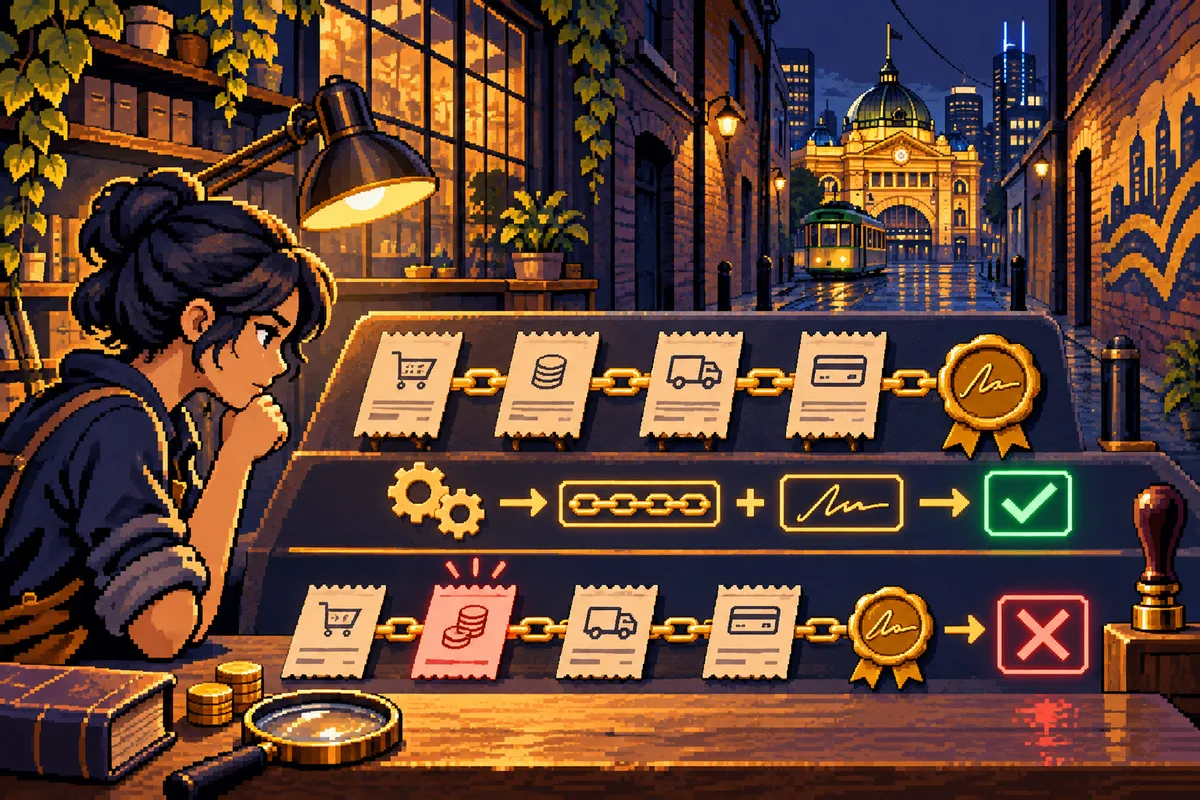
Create a small fictional receipt with amount, currency, timestamp and previous entry digest. Serialize with a specified canonical encoding, hash it and sign using an asymmetric test key. Give the verifier the public key through a trusted channel. A hash chain can connect records, and a signature binds the payload to the key.
Construct two synthetic receipts that share one field value but have different receipt IDs and previous digests. Verify each record and the chain as separate checks. If the last record is removed, an offline verifier needs a trusted expected head to know the tail was truncated. State whether that extra anchor is available.
Watch the failure boundary
Sign a domain-specific payload so a receipt signature cannot be reused as proof for another operation. Record the algorithm and key identifier alongside the packet. A key rotation can leave historical receipts valid if the verifier retains trusted public keys for those periods. Test verification after a rotation with two fictional keys.
Verify the behavior
Change one digit in the amount, remove a middle record and swap two records. Verify that each edit is detected. A correctly signed document can still describe incorrect source data, and checking an offline packet does not establish a provider’s latest payment state.
Sources
Technical references checked .

Eeshan Singh
I’m Eeshan Singh Pokharia, an AI Full Stack Developer and CoFounder of UltraFit360. I work across AI features, full-stack product development, and web and mobile experiences—from Figma and frontend interactions to the systems behind them.
Sign a domain-specific payload so a receipt signature cannot be reused as proof for another operation. Record the algorithm and key identifier alongside the packet. A key rotation can leave historical receipts valid if the verifier retains trusted public keys for those periods. Test verification after a rotation with two fictional keys.
Meet the author