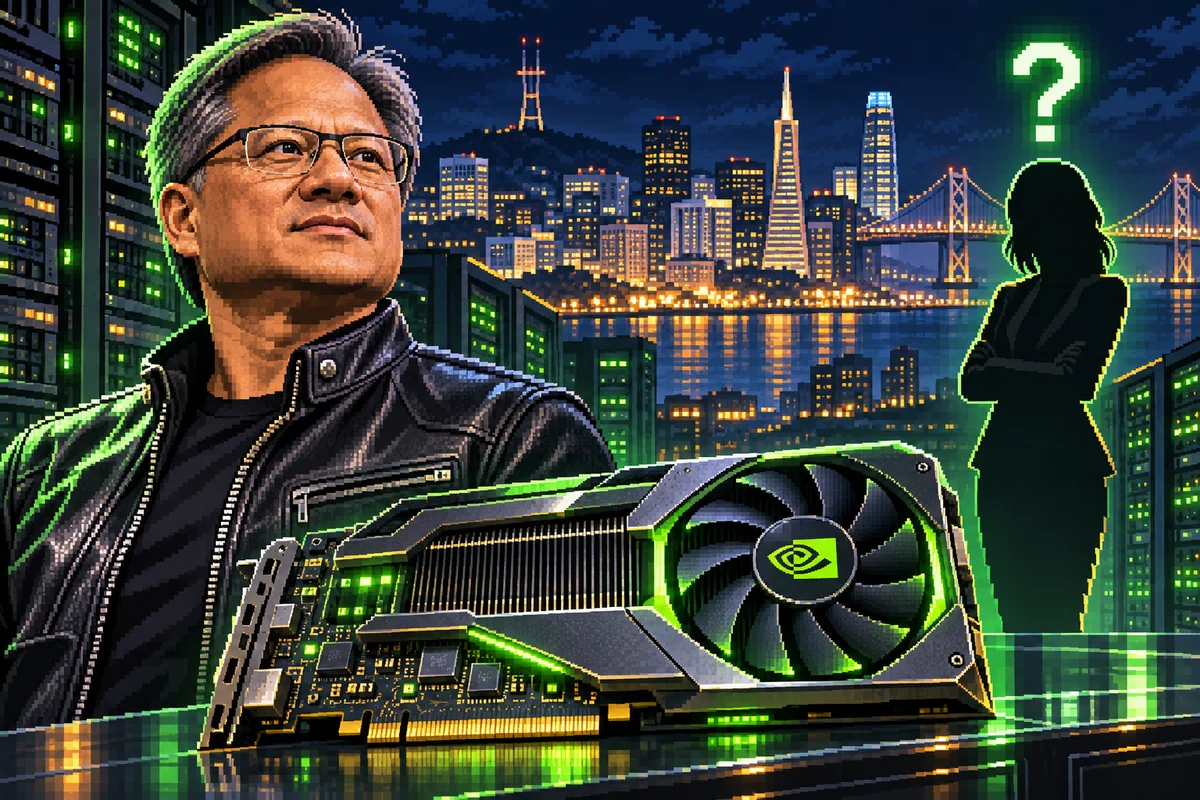
The Jensen Huang investigation raises an important question for the AI industry: what happens when confidence in a central technology supplier is shaken? NVIDIA announced an independent inquiry on 8 November 2026, while saying its board had no reason to believe national security or company secrets were compromised. That distinction matters. An investigation, a stock-market reaction and an actual technology leak are different events. Here is what is established, what remains conditional, and how developers should think about the China AI race, cloud dependence and local LLMs. Reporting checked on 9 November 2026.
What is the Jensen Huang investigation actually about?
NVIDIA’s board says its inquiry follows reporting about a possible foreign-intelligence effort targeting its CEO. Independent directors and outside counsel will oversee the review. Huang separately acknowledged infidelity in a public employee message; that admission does not establish espionage. The company has expressed confidence in his leadership. Those are the relevant official statements, rather than a completed account of what investigators will find.
China’s foreign ministry rejected the spy allegation on 9 November. Its response should appear alongside the allegation, with attribution. Neither an official denial nor a company statement independently resolves disputed events. For a reader trying to understand the technology implications, the unresolved question is whether any protected information or access was compromised, and if so, what it was.
There is a temptation to jump from a personal admission to a national-security conclusion because the combined headline is dramatic. That shortcut removes the evidence the conclusion requires. This article keeps the public inquiry separate from hypothetical consequences and leaves family details outside the analysis.
Why NVIDIA stock reacted — and what a price fall cannot tell us
Reuters reported that NVIDIA fell more than 6% in Frankfurt trading on 9 November, extending an earlier selloff. That is a reported snapshot in a particular market, not a US closing return. Prices move during the day, and a percentage without a venue, session and reference time can be misleading. A live price widget beside an older report may show something different without invalidating the report’s historical observation.
My interpretation is that investors have several questions to price: leadership continuity, potential regulatory consequences and the confidence of customers and partners. A company can possess valuable technology while investors become less comfortable with uncertainty about its management. The price of a share expresses expectations about future outcomes; it is not a forensic assessment of what information changed hands.
Broader AI-spending concerns can also coexist with company-specific news. To assess the relative move properly, compare NVIDIA with semiconductor and technology benchmarks over the same complete trading sessions, then account for earnings and other major announcements. Even that comparison supplies context rather than a controlled causal experiment. One day’s chart cannot separate every reason buyers and sellers acted.
For developers, the operational questions are more concrete: did the supplier change delivery commitments, did an API become unavailable, or did an actual policy change affect the hardware we can obtain? Those need their own evidence. This explainer offers no price target or recommendation to buy or sell a security.
If information reached China, what kind would matter?
“Data was given to China” is too vague to explain a technical risk. A public product slide, a confidential roadmap and an infrastructure credential are all information, but their consequences differ enormously. The categories below are hypothetical. They describe how to evaluate a verified disclosure if one is established; they are not a list of assets known to have been exposed in this case.
Commercial information might help a competitor understand demand, allocation or negotiating positions. Technical implementation details could present a different intellectual-property problem. Access credentials could raise immediate incident-response questions. The material’s sensitivity, freshness, completeness and practical usefulness would all affect the outcome. Simply calling it “AI data” tells the reader none of those things.
A further distinction matters for people who use AI products: a chip supplier does not automatically possess every customer’s private prompts, training datasets or model weights. Being part of an infrastructure supply chain is not the same as having access to all applications built on that infrastructure. Any claim about customer exposure needs evidence of the actual access path.
Scroll the table horizontally to see all columns.
| Hypothetical information | Possible consequence | Evidence needed |
|---|---|---|
| Public sales material | Little additional information advantage | Check what was already public |
| Nonpublic orders or allocation | Commercial insight into demand and shortages | Identify records and unauthorized disclosure |
| Product roadmap or chip design | Potential competitive or IP consequences | Establish technical scope and authenticity |
| Credentials or system access | Potential exposure of reachable systems | Verify access logs and affected assets |
| Customer model weights | Model-specific exposure if accessible | Identify owner, material and actual access path |
Would a technology leak change the US–China AI race?
It could matter if important nonpublic technology were genuinely compromised, but magnitude cannot be inferred from a headline. An AI advantage involves compute access, manufacturing, model efficiency, software tools, deployment experience and distribution. Improving one part does not instantly replace the others. That is why “China wins” is an unsupported conclusion from the evidence currently available.
NVIDIA’s October supply-chain announcement describes work across substrates, advanced packaging, testing and optical components. The practical lesson is that an accelerator reaches users through an industrial system. Possessing a design document would not, by itself, supply fabrication capacity, working packaging, qualified components and reliable production. That is engineering analysis of the dependencies, not a finding about any alleged disclosure.
Export controls add another layer. A January 2026 US rule introduced conditional case-by-case review for specified advanced-computing exports, including H200-class products. It was not blanket approval for every customer or chip. That dated rule is policy context; it does not establish the status of a particular transaction today. A later restriction or approval would need to be read on its own terms.
China’s model ecosystem also has its own software distribution path. Qwen’s official documentation supports local execution and server deployment. That availability is relevant to the AI race without being evidence of improper access to NVIDIA information. Evaluate the provenance, license and deployment of a specific model rather than treating an entire country’s developers as one security category.
A design is one part of the AI compute stack
A conceptual dependency map, not a description of information exposed in the investigation.
Build the hardware
- Design and software
Architecture, implementation and developer tools.
- Manufacture and assemble
Fabrication, packaging, components and testing.
Deliver useful AI
- Operate the systems
Power, networking, cooling and reliable deployment.
- Serve a workload
Models, applications, evaluation and customer value.
A hypothetical disclosure does not automatically reproduce the whole system.
Does this signal the fall of AI?
The evidence reviewed does not support that claim. A valuation shock, a governance problem, a chip-supply interruption and falling product demand are four different developments. They can influence one another, but none should be substituted for another. Installed GPUs do not stop executing because a supplier’s shares decline. A demonstrated hardware problem or service interruption would require separate reporting.
There are plausible second-order risks worth watching. If financing becomes more expensive, some planned infrastructure investments could become harder to fund. If deliveries slow, customers may reconsider their capacity plans. If a compliance burden changes, procurement could take longer. These are conditional mechanisms, not events established by this investigation. Before claiming they happened, look for actual financing decisions, order changes, pricing data or official rules.
The more useful industry question is concentration: how much of a product’s future depends on one supplier, one hosted endpoint or one commercial relationship? That question remains valuable whether the investigation ultimately finds material compromise or not. Resilience is about understanding dependencies before a disruption makes them obvious.
Could local LLMs benefit — and can they run without NVIDIA?
Local models fit this discussion through control, not through a proven investigation-driven adoption boom. I have not obtained evidence that this event caused users to migrate from cloud AI to local LLMs. A plausible reason someone might reconsider a dependency is not the same as a measured trend. Local inference already offers a way to choose where selected workloads execute.
Running locally also does not mean avoiding NVIDIA. The llama.cpp project supports NVIDIA CUDA alongside alternatives such as AMD HIP, Apple Metal and CPU execution. The suitable choice depends on the model, memory capacity and workload. Hardware independence and execution location are separate decisions: you can run locally on an NVIDIA GPU, or use another supported device.
Apple’s MLX developer material explains local LLM work on Apple silicon and how quantization reduces memory requirements. That helps explain why smaller or quantized models can be practical for some tasks. It does not mean every laptop can run every large model, or that a reduced model preserves identical quality. Measure the task you care about, including long inputs, response latency and failure cases.
The local-versus-cloud decision should start with the job. Extracting a few fields from an approved document, drafting offline notes and handling a complex tool-using workflow can have very different quality requirements. A useful evaluation measures whether the output is correct enough for that particular purpose. A model’s ability to answer a casual question is a weak substitute for testing the actual workflow.
Local AI privacy depends on the complete data path
Ollama’s FAQ distinguishes local inference from its cloud-hosted models and documents how to disable cloud features. That distinction is a good example of why the word “local” needs checking in the actual configuration. A desktop application can still call a remote model, search service or external tool. Where the window appears does not prove where its data is processed.
Think through a hypothetical document assistant. Reading the document and generating an answer on the same device can keep that part of the workflow local. Sending a passage to a hosted search tool, storing debug logs remotely or invoking an external agent tool creates additional paths. The application needs to disclose and constrain those paths. This example describes an architecture to inspect, not an incident in UltraFit360.
Open weights, local execution and privacy are related but distinct. Access to model parameters does not audit the runtime or dependencies. Local execution does not secure an exposed inference server. A permissive model license does not establish that a model is appropriate for every use. A responsible setup checks the model’s license, network behavior, access controls, logs and update process separately.
Where does the prompt actually travel?
Illustrative application paths. Verify the configuration of your own tools.
Local path
- Device input
The document is read on hardware you control.
- Local inference
Check that generation stays on the device.
External path
- Cloud model or tool
An optional integration can transmit selected input.
- Provider handling
Review destination, retention, access and logging.
A local interface is not proof that every operation stays local.
What developers and startups can do without panic-switching
Start with a dependency inventory. Write down which features need a cloud response, which records remain usable without it, and where sensitive input is sent. Then define the failure behavior: a saved record should not disappear just because a new explanation cannot be generated. Users need a truthful unavailable state, not a successful-looking screen that hides uncertainty.
If switching providers is a meaningful business requirement, make the boundary explicit. Keep provider-specific request formatting away from the application’s core records and user-interface states. Test an alternate endpoint against a small representative evaluation set before calling it a fallback. Responses can differ in structure, tool behavior and quality; matching an API shape is not proof of equivalent product behavior.
A hybrid design can keep selected tasks local while escalating others to an approved cloud service, but it adds routing and operational complexity. Measure correctness, latency, hardware cost and maintenance. The right answer may still be a cloud provider for your workload. The point is to make a deliberate choice with known tradeoffs rather than replacing a dependency because of an alarming headline.
Scroll the table horizontally to see all columns.
| Option | Reason to consider it | What to test |
|---|---|---|
| Local model | Offline work and control over selected data | Memory, output quality, network behavior and device security |
| Cloud API | Managed operations and variable capacity | Provider terms, availability, cost and error handling |
| Hybrid routing | Different workloads need different boundaries | Routing rules, disclosure and safe escalation |
What would materially change this analysis?
The next useful developments would be published investigation findings, an official leadership announcement, specific regulatory action, or verified evidence of operational consequences. Each answers a different question. A new rumor that repeats an old allegation does not carry the same weight as identified assets, documented access and a finding with a stated scope.
If the review finds no material compromise, the security narrative may narrow while governance discussion continues. If commercial or technical information was compromised, its exact nature would determine the response. If policy changes, the effective date and affected transactions matter. These scenarios are deliberately conditional; assigning invented probabilities would make uncertainty look more measurable than it is.
First published 9 November 2026. This article separates official statements, reported market observations and original analysis. It should be updated when substantive evidence changes, rather than having its wording refreshed daily to imply new reporting. For now, the strongest practical lesson is to understand the systems your AI product depends on and the evidence behind every claim about them.
Frequently asked questions
Did NVIDIA confirm that its secrets were leaked to China? No. As checked on 9 November 2026, NVIDIA announced an independent investigation and said its board had no reason to believe national security or company secrets were compromised. An inquiry is not a completed finding.
Does the Jensen Huang investigation mean the AI boom is over? The investigation alone does not establish that. Share prices, leadership continuity, chip deliveries and demand for AI products need separate evidence. A market decline does not switch off installed hardware or measure every AI product’s usefulness.
Can I run a local LLM without an NVIDIA GPU? Yes, compatible runtimes support alternatives including Apple silicon, AMD GPUs and CPUs. Model size, memory, quantization and workload determine practicality. Local execution also needs a checked data path: cloud tools or logging can still send information elsewhere.
Sources
- NVIDIA board statement — 8 November 2026
- NVIDIA: A Message to Our Company
- China MFA transcript — 9 November 2026
- Reuters: NVIDIA shares and the investigation
- NVIDIA manufacturing capacity announcement
- US Federal Register: January export-review rule
- Qwen official documentation
- llama.cpp official documentation
- Ollama official FAQ
- Apple: Get started with MLX
Technical references checked .

Eeshan Singh
I’m Eeshan Singh Pokharia, an AI Full Stack Developer and CoFounder of UltraFit360. I work across AI features, full-stack product development, and web and mobile experiences—from Figma and frontend interactions to the systems behind them.
As an AI Full Stack Developer and UltraFit360 cofounder, I care about what a technology dependency means for a working product: where data goes, whether saved features survive an outage, and how difficult switching providers would be. This is sourced industry analysis, not firsthand knowledge of NVIDIA’s investigation or a claim about private product incidents.
Meet the author