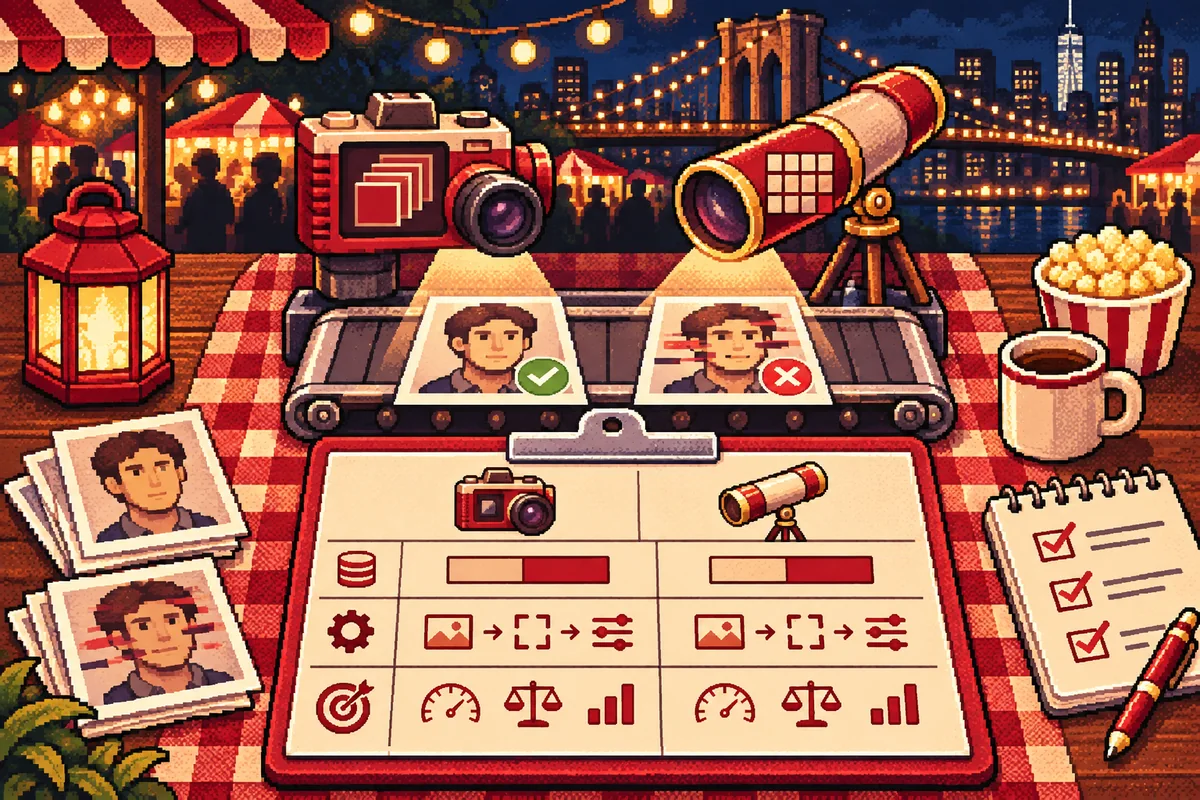
Train on one collection and test on another to find out whether a deepfake detector recognizes manipulations or familiar datasets.
Build the example
Split the source corpus by person and original video before extracting frames. Tune a threshold on source validation data and freeze it for external testing. Match evaluation units and report performance per clip so a long video does not dominate. Compare image resolution, codec and manipulation distribution across sets.
Make a manifest with corpus, original video ID, identity group and transformation type. Put a duplicate group in a toy manifest and assert the split checker rejects it. After training, export the predictions and verify clip-level aggregation on a small subset by hand. This catches frame-count effects before you interpret the external test.
Cross-dataset evaluation
Train on one collection and test on another to find out whether a deepfake detector recognizes manipulations or familiar datasets.
Example
- Source training
fit on source identities
- Source validation
freeze the threshold
- External test
report at the fixed threshold
report at the fixed threshold
Watch the failure boundary
Check for the same public source clip appearing in both corpora under different encodings. A simple metadata comparison can find some duplicates, while an image or audio fingerprint can reveal near matches. Document the deduplication rule and keep an example of an excluded pair, using media you can share.
Verify the behavior
Build a table with a source-test row and an external-test row, both with class counts, precision and recall. Look for performance changes within slices. Any drop identifies a generalization problem under this protocol. It does not establish a universal accuracy for either dataset or explain the cause on its own.
Sources
Technical references checked .

Eeshan Singh
I’m Eeshan Singh Pokharia, an AI Full Stack Developer and CoFounder of UltraFit360. I work across AI features, full-stack product development, and web and mobile experiences—from Figma and frontend interactions to the systems behind them.
Check for the same public source clip appearing in both corpora under different encodings. A simple metadata comparison can find some duplicates, while an image or audio fingerprint can reveal near matches. Document the deduplication rule and keep an example of an excluded pair, using media you can share.
Meet the author